
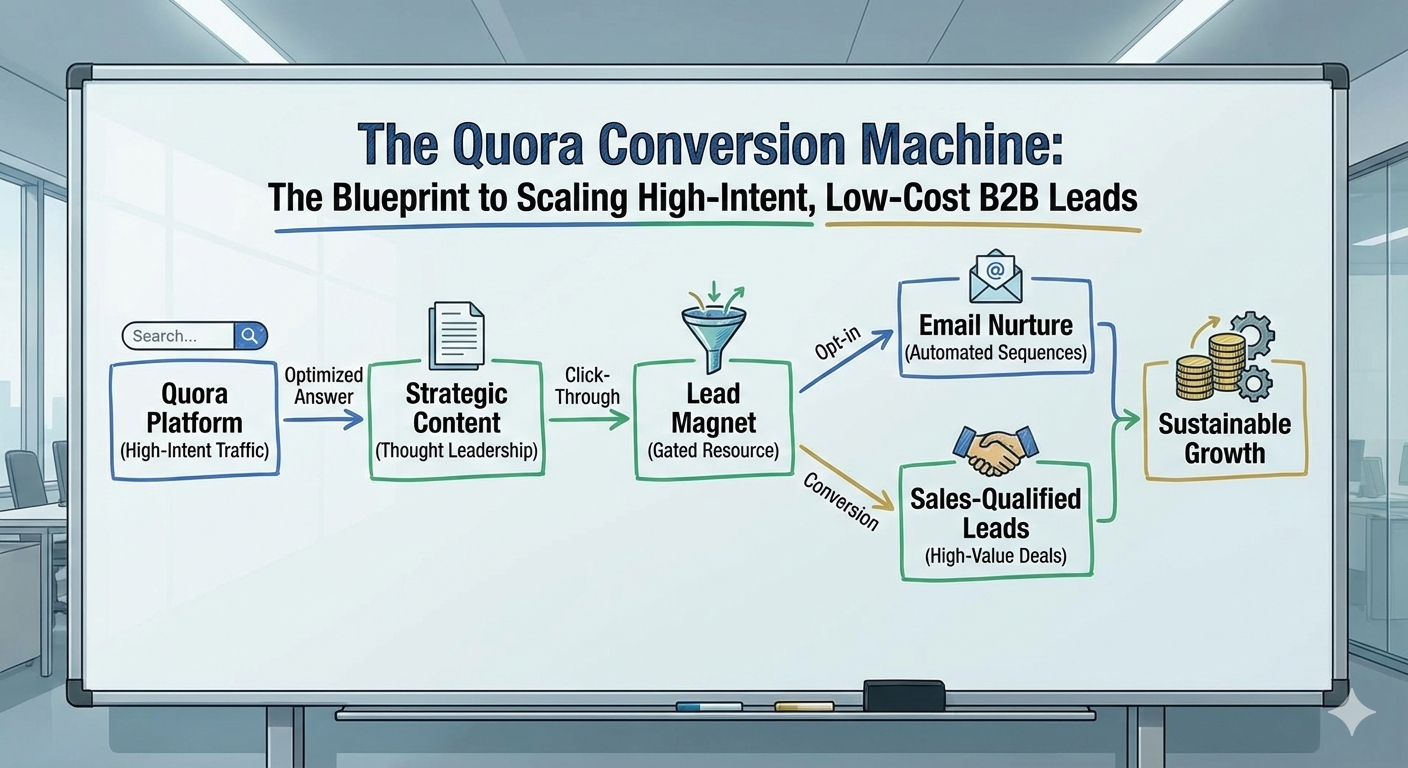
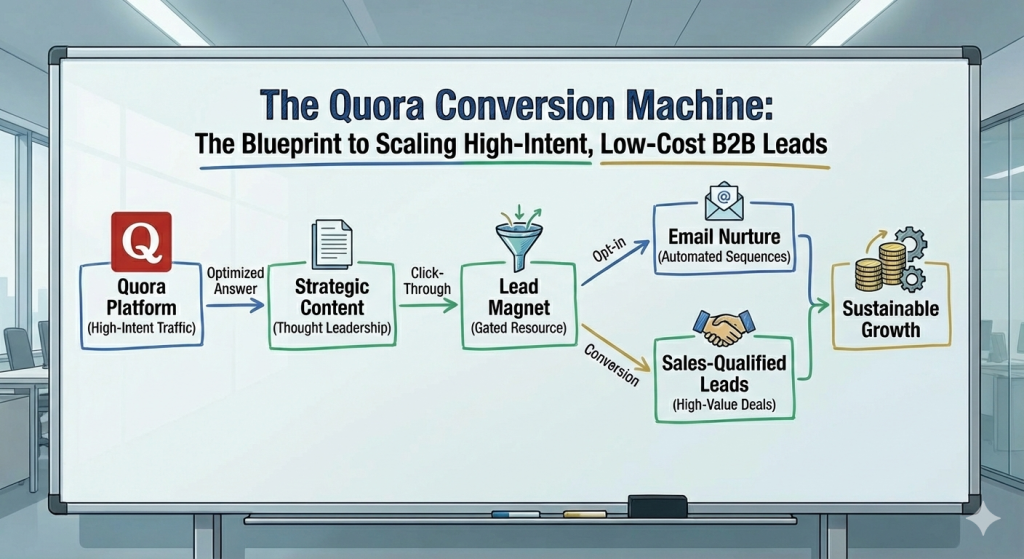
Section 1: The “Search-Social” Hybrid Advantage
Most advertisers live in a binary world dominated by two giants: Google and Facebook. You either pay a premium for high-intent search traffic on Google, where users are actively looking for a solution, or you fight for attention in the social feeds of Facebook, where users are there to connect with friends and have their guard up against marketing.😊
But there is a third, often overlooked dimension where the rules of the game change in your favor: Quora.
To master Quora Ads, you must first understand that Quora is not just a social network, nor is it merely a search engine. It occupies a unique psychological space—a “Search-Social Hybrid.” This dual nature is the secret weapon that allows B2B advertisers to generate high-quality leads at a fraction of the cost of the major platforms.
Why the “Search-Social” Hybrid Matters
1. The Intent of Search (Without the Search Price Tag)
Unlike Facebook, where you are interrupting a user’s social time, Quora users are often in “problem-solving mode.” They are actively seeking answers, advice, and comparisons. They are asking questions like, “Which CRM is best for small B2B startups?” or “How do I scale my content marketing team?”
However, unlike Google Ads, where you are bidding on keywords in a hyper-competitive auction that drives costs through the roof, Quora allows you to intercept this intent within a content consumption environment. The user is already in the mindset of reading and learning, which makes them far more receptive to a well-placed solution.
2. The “Google Search Proxy” Effect
One of the most powerful, yet least understood, advantages of Quora is its massive footprint on Google Search results. As noted in our case studies, Quora pages frequently rank in the top positions for high-volume, long-tail keywords.
Here is how the “Intent Chain” works:
- Step A: A user Googles a problem (e.g., “best SaaS marketing agency”).
- Step B: A Quora thread appears at the top of the organic results.
- Step C: The user clicks through to Quora to read the answers.
- Step D: Your Ad sits right alongside those organic answers.
Because the user arrived at Quora via a Google search, their intent is already primed. They are “warm” before they even see your ad. You are effectively piggybacking off Google’s high-intent traffic but paying Quora’s lower display-ad prices.
DOWNLOAD THIS BLUEPRINT USING THE FORM BELOW
The Cost-Performance “Sweet Spot”
Data from advertisers spending over $200k on the platform confirms that Quora consistently offers a middle ground that maximizes ROI.
- Compared to Google Ads: Quora ads can be 60–95% cheaper per click than Google Search campaigns. While Google provides direct intent, the cost per acquisition (CPA) is often prohibitively high for B2B businesses. Quora captures that same intent but at a significantly lower entry cost.
- Compared to Facebook Ads: Quora ads are often 40–50% cheaper per click than Facebook, but with a drastically higher engagement quality. Facebook users often “scroll past” ads. Quora users are there to read text—meaning they actually stop to look at your copy.
Visualizing the Funnel: The “Goldilocks” Zone
To visualize where Quora sits, imagine a graph where the X-axis is User Intent (how likely they are to buy) and the Y-axis is Cost Per Click (CPC).
[Concept Illustration: The Three-Layer Funnel]
- Top Layer (Google): High Intent / Very High Cost. (You get leads, but margins are thin).
- Bottom Layer (Facebook): Low Intent / Low-to-Medium Cost. (Cheap clicks, but users often aren’t looking to buy B2B services).
- The Sweet Spot (Quora): High Intent / Low Cost. This is the optimal zone for B2B advertisers. The user is searching for answers (High Intent), but because the platform is less saturated than Google, the competition for ad space is lower (Low Cost).
The Traffic Quality Warning
It is important to note that this “Sweet Spot” is conditional. One of the reviews we analyzed highlighted a “too good to be true” scenario where traffic was cheap but converted poorly. This usually happens when advertisers treat Quora like Facebook (using broad, “spray and pray” tactics).
When you leverage the Search-Social Hybrid correctly—targeting specific questions and keywords—you filter out the “browsers” and attract only the “researchers.” The difference is night and day: one user spends 2 seconds on your site (the browser), the other spends 8 minutes and fills out a detailed consultation form (the researcher).
Key Takeaways for This Section
- Do: Treat Quora traffic as “search intent.” Write your ad copy assuming the user is actively looking for a solution to a problem.
- Don’t: Treat Quora traffic like Facebook “social traffic.” Avoid clickbait or generic brand awareness ads that don’t address a specific pain point.
- Do: Capitalize on Quora’s high Google rankings. When choosing keywords to target on Quora, think about what people are typing into Google that leads them to Quora.
- Don’t: Ignore the platform’s unique culture. Quora users value depth and expertise. Your ads must reflect the intellectual nature of the platform.
Section 2: The Infrastructure Flow: Pixels, GTM, and Event Tracking
If traffic is the fuel for your advertising engine, tracking is the navigation system. Without it, you are driving blindfolded. You might be generating clicks, but you won’t know which users are valuable, which are bouncing, and which ads are actually driving revenue.
In the world of Quora Ads, the difference between a profitable campaign and a money pit lies in the quality of your data. The Quora Pixel is the bridge between the ad platform and your website, and setting it up correctly is non-negotiable for generating “huge conversions.”
The Backbone: The Quora Pixel
The Quora Pixel is a small piece of JavaScript code that functions almost identically to the Facebook Pixel or Google Analytics. Once installed on your site, it tracks the actions users take after clicking on your ad.
But why is it so critical for Quora specifically? As seen in our case studies, Quora’s algorithm heavily favors relevance. When the Pixel feeds conversion data back to Quora, the platform learns exactly who is converting. It then looks for more people who match that profile. The team that generated $12,000 in revenue attributed a significant portion of their success to letting the Pixel optimize their delivery.
The Implementation Strategy: Google Tag Manager (GTM)
While you can copy-paste the Quora Pixel code directly into the header of your website, we strongly advise against it.
Hard-coding pixels slows down your site and creates a “spaghetti code” nightmare if you ever need to update them. The industry standard—and the method recommended by top marketers—is to use Google Tag Manager (GTM).
Why GTM is a Game Changer:
- Clean Architecture: GTM sits as a single layer on your website. You manage all your tags (Quora, Facebook, Google Analytics) inside the GTM interface without ever touching your website’s source code again.
- Event Flexibility: GTM allows you to track complex user behaviors. You aren’t just tracking page loads; you can track when a user scrolls 50% down the page, hovers over a pricing button, or clicks a specific “Chat Now” widget.
The Conversion Flow: A Step-by-Step Visualization
To understand how tracking helps you scale, visualize the path a user takes. This is the logic flow we use to structure our tracking setup.
[Concept Illustration: The Data Feedback Loop Flowchart]
1. The Trigger: A user sees your High-Intent Quora Ad.
2. The Click: Quora records a “Click” and fires the View Content event via the Pixel.
3. The Arrival: The user lands on your B2B Landing Page.
4. The Action: The user reads your copy and decides to fill out a “Request Consultation” form.
5. The Pixel Fire: Upon form submission, the Generate Lead event fires back to Quora.
6. The Optimization: Quora’s algorithm receives this “Conversion” signal and adjusts its targeting to find more users who look like the one who just submitted the form.
Defining Your Key Events
To generate high revenue, you must move beyond tracking “Page Views.” Page views are vanity metrics; conversions are sanity metrics. In Quora Ads Manager, you should configure the Pixel to track these specific B2B events:
- Generate Lead: Fires when a user submits a contact form or downloads an ebook. This is the most critical metric for B2B.
- Purchase: Fires if a user buys a SaaS subscription or service directly on the page.
- Add to Cart: Fires when a user initiates a checkout process (useful for identifying high-intent users who didn’t finish buying).
- Sign Up: Fires when a user creates a free trial account.
The “Ghost Click” Problem: Validating Your Data
One of the reviews we analyzed highlighted a disturbing discrepancy: An advertiser saw 6,619 clicks in Quora but only 1,640 pageviews on their website. This suggests “spam” or bot traffic, or technical errors.
How proper setup solves this:
If your Quora Pixel is installed on the landing page, Quora will report the number of “Page Views” it recorded on its end. You can then cross-reference this number with Google Analytics.
- If the numbers match: The traffic is real. If they aren’t buying, your landing page or offer is the problem.
- If the numbers are vastly different (like the 6,000 vs 1,600 case): You have a technical issue. The user might be bouncing immediately, or there is a tracking error.
By setting up the Pixel to track time on site (e.g., firing an event if a user stays on the site for more than 30 seconds), you can filter out low-quality traffic. If you see thousands of clicks but zero “Time on Site” events, you know the traffic quality is poor and you can kill that campaign immediately.
The Power of Remarketing
The Quora Pixel does more than just track; it builds audiences. It creates a list of everyone who visited your site but didn’t convert.
In a later section, we will discuss strategy, but for now, understand that you cannot run remarketing campaigns without this Pixel. If a user visits your pricing page but leaves, you can use the Pixel data to show them a follow-up ad on Quora a few days later with a specific case study or a discount offer. This is often where the “easy” sales come from.
Technical Implementation Checklist
Before you spend a single dollar on traffic, ensure you have checked these boxes:
- [ ] Pixel Base Code Installed: Is the Quora Pixel firing on every page of your site via GTM?
- [ ] “ViewContent” Standard Event: Is Quora registering a page view every time a user lands on your site?
- [ ] “GenerateLead” Custom Event: Have you set up a trigger in GTM to fire the ‘Generate Lead’ event specifically when the “Submit” button on your contact form is clicked?
- [ ] Cross-Reference Test: Run a $10 test campaign. Do the clicks reported in Quora roughly match the Users reported in Google Analytics? (80% match is acceptable; 20% match indicates a problem).
- [ ] Value Tracking: Are you passing the dynamic value of the lead (e.g., “$100 potential value”) to the Pixel? This allows Quora to optimize for Revenue rather than just Leads.
Key Takeaways for This Section
- Do: Use Google Tag Manager (GTR) to host your Quora Pixel. It saves hours of developer time and allows for advanced event tracking.
- Don’t: Rely solely on Quora’s “Clicks” metric. Always cross-reference with Google Analytics to ensure you are paying for real human traffic.
- Do: Implement the “Generate Lead” event specifically on your form submission button, not just the “Thank You” page (to track users who drop off or hit the back button).
- Don’t: Start spending heavily until you have verified that the Pixel is firing correctly. Data accuracy is your first line of defense against wasted ad spend.
Section 3: The Architecture of Scale: Structuring Campaigns for Delivery
One of the biggest mistakes advertisers make when migrating from Facebook or Google Ads to Quora is assuming the campaign hierarchy works the same way. It does not.
If you simply create one “Master Campaign” and stuff multiple ad sets with different targets and bids inside it, you are inadvertently sabotaging your own results. Quora’s delivery algorithm has a specific quirk: it aggressively favors the highest bid, regardless of how well an ad is actually performing.
To scale from a $1,000 test spend to a $200,000+ monthly spend machine, you must build a rigid “Architecture of Scale.” This structure ensures that every segment of your audience gets a fair chance to perform, and your budget is allocated efficiently.
The Fundamental Flaw: Budget vs. Bid Placement
Here is the problem with Quora’s structure:
- Budgets are set at the Campaign Level.
- Bids are set at the Ad Set Level.
If you create one campaign with a $50 daily budget and place two ad sets inside it—Ad Set A with a $0.50 bid and Ad Set B with a $1.50 bid—Quora will dump almost the entire budget into Ad Set B.
Why? Because Quora prioritizes ad delivery based on bid size. Ad Set A might have better engagement or a higher conversion rate, but because the bid is lower, the algorithm will starve it of impressions. You end up scaling the wrong ad set simply because you bid higher on it.
The Golden Rule: One Campaign Per Ad Set
The solution, used by top-tier advertisers managing six-figure budgets, is counter-intuitive but highly effective: Run only one ad set per campaign.
This forces the algorithm to spend your budget exactly where you want it. It creates a controlled environment where you can fine-tune the bid for that specific audience segment without worrying about it cannibalizing the budget of another segment.
While this means you will end up managing 20 campaigns instead of 5, the control and performance improvement are worth the administrative effort.
The Architecture Diagram
To visualize this structure, imagine your account not as a bucket, but as a precise filing cabinet.
[Concept Illustration: The High-Scale Campaign Tree]
Root Node: Objective (e.g., Conversions)
Branch 1: [USA – Desktop]
- Campaign: US – Desktop – Conversions (Budget: $30/day)
- Ad Set: US – Desktop Targeting (Bid: $3.40)
Branch 2: [USA – Mobile]
- Campaign: US – Mobile – Conversions (Budget: $20/day)
- Ad Set: US – Mobile Targeting (Bid: $0.40)
Branch 3: [UK – Desktop]
- Campaign: UK – Desktop – Conversions (Budget: $15/day)
- Ad Set: UK – Desktop Targeting (Bid: $2.50)
Branch 4: [Developing Markets – Mobile]
- Campaign: Emerging Markets – Mobile (Budget: $10/day)
- Ad Set: Tier 2 Countries – Mobile (Bid: $0.20)
Why Device Segmentation is Non-Negotiable
As highlighted in our earlier case studies, the user behavior and economics of Mobile vs. Desktop users on Quora are drastically different.
- The Bid Disparity: In one successful campaign, the optimal bid for Desktop was $3.40, while the optimal bid for Mobile was only $0.40.
- The Engagement Gap: Mobile users tend to scroll faster (higher impressions, lower depth), while Desktop users are in “research mode” (lower impressions, higher time-on-site).
If you lump Mobile and Desktop into a single ad set, you have to pick a single bid.
- If you bid $3.40 to win Desktop traffic, you are drastically overpaying for Mobile traffic, killing your ROI.
- If you bid $0.40 to stay safe on Mobile, you will win zero Desktop auctions.
By separating them into different campaigns (as shown in the diagram above), you can assign a high budget and high bid to the profitable Desktop segment, while running a lean, cheap operation on Mobile.
Geography Batching: When to Group and When to Split
While we recommend a “One Ad Set Per Campaign” approach, you don’t necessarily need a separate campaign for every single country.
- Split: When countries have vastly different purchasing power or time zones. (e.g., USA vs. Philippines).
- Group: When countries are economically similar and in the same time zone. (e.g., UK, Germany, France).
In the “Major Review,” the advertiser grouped four similar European countries into one campaign. They observed that impressions were distributed proportionally to the population of those countries, and since the Cost Per Click (CPC) was similar across them, it didn’t hurt performance. This is a great way to reduce account clutter while maintaining control.
The “Winning” Workflow: How to Manage This Structure
Managing 50+ campaigns sounds daunting, but it creates a rhythm of optimization that prevents wasted spend.
- Launch: Create your segmented campaigns (US-Desktop, US-Mobile, etc.).
- Monitor (Days 1-3): Look at Impression Share.
- If an Ad Set has 0% Impression Share, the bid is too low. Increase it.
- If an Ad Set hits 100% Impression Share immediately but spends the budget in 2 hours, the bid is likely too high (you are overpaying). Lower it slightly to spread the budget throughout the day.
- Analyze (Day 7): Compare the Cost Per Acquisition (CPA) of US-Desktop vs. US-Mobile.
- Allocate: Kill the Mobile campaign if it isn’t converting, and shift that budget to the Desktop campaign.
Campaign Structure Template
Use this mental template every time you launch a new offer:
| Campaign Name | Ad Set Targeting | Device | Daily Budget | Max CPC Bid | Status |
|---|---|---|---|---|---|
| [Offer] – US – Desk | Topic: Marketing; Geo: US | Desktop | $50 | $3.00 | Active |
| [Offer] – US – Mobile | Topic: Marketing; Geo: US | Mobile | $20 | $0.50 | Active |
| [Offer] – EU – Desk | Topic: Marketing; Geo: UK/DE/FR | Desktop | $30 | $2.50 | Active |
| [Offer] – ROW – Mobile | Topic: Marketing; Geo: Rest of World | Mobile | $10 | $0.20 | Testing |
Key Takeaways for This Section
- Do: Adopt the “One Campaign Per Ad Set” architecture. It is the only way to stop the algorithm from favoring high bids over high performance.
- Don’t: Combine Mobile and Desktop targeting in the same ad set. The bid economics are too different; you will inevitably lose money on one or the other.
- Do: Group similar geographies (like Western Europe) into one campaign to save management time, provided the CPCs are stable.
- Don’t: Let “zombie” campaigns sit at 0% impression share. If you aren’t winning auctions, your ad structure is technically running, but it’s invisible to the world.
Section 4: The “Question Mining” Algorithm
Targeting is the engine of your Quora Ads machine. If you target broad topics like “Digital Marketing” or “Software,” you will burn through your budget with low-quality leads. If you rely solely on behavioral targeting (the “black box” method), you are trusting an algorithm to guess who might be interested.
To generate the highest ROI and truly massive conversions, you must abandon the shotgun approach and embrace the sniper approach: Question Targeting.
Quora allows you to bid on individual questions (URLs). This means your ad can appear specifically on the page that answers, “What is the best CRM for a real estate agency with under 20 agents?” instead of broadly on any page about CRMs. The user reading that specific question is your exact ideal customer. However, finding these golden needles in the haystack requires a systematic process we call the Question Mining Algorithm.
The “Topic” Trap vs. The “Question” Goldmine
Many beginners stop at Contextual Targeting -> Topics. They select “B2B Marketing” and let Quora decide where to show the ads. While easier, this is inefficient. Quora’s labeling of topics can be messy, often placing your ad in front of users interested in vaguely related concepts.
Question Targeting, on the other hand, offers complete placement control. You control the exact environment where your ad appears. But the challenge is volume. Manually searching for questions is tedious.
The 5-Step Question Mining Workflow
This workflow combines Quora’s internal data with third-party SEO intelligence to find questions that have high volume and high buyer intent.
[Concept Illustration: The Question Mining Flowchart]
Step 1: Seed Generation
- List 10-20 keywords describing your product (e.g., “accounting software”).
- List your competitors and their products.
- List problems your audience faces (e.g., “fixing cash flow problems”).
Step 2: The Quora Bulk Import
- Go to Quora Ads Manager -> Ad Set -> Targeting -> Bulk Add.
- Input your seed keywords.
- Output: Quora generates a list of questions sorted by estimated “Weekly Views.”
Step 3: The Data Export
- Instead of blindly selecting questions, use an SEO Toolbar (like Ahrefs or Semrush) to export the list of URLs Quora suggested.
- Paste this list into the SEO tool’s “Batch Analysis” feature.
Step 4: The Organic Traffic Filter
- Analyze the “Organic Traffic” metric for each question.
- Crucial Insight: Some questions have low views on Quora but massive traffic from Google Search. These are “Sleeping Giants.”
Step 5: Selection & Categorization
- Select the top 50 questions that have a balance of high Organic Traffic and high relevance.
- Load these into your Ad Set.
Why the SEO Layer is Your “Unfair Advantage”
A question might only get 100 views a week from Quora users browsing the site. However, that same page might rank #1 on Google for a high-intent keyword and receive 10,000 visits per month from search engines.
When you place an ad on that question, you are essentially intercepting that high-value Google search traffic. Most advertisers only look at “Weekly Views” inside Quora’s interface. By adding the SEO layer (Step 3 & 4), you discover high-value inventory that your competitors are ignoring because it looks “dead” inside Quora’s dashboard.
The “50 Question” Limit Strategy
Quora caps the number of questions you can target per ad set at 50.
This limit is actually a blessing in disguise. It forces you to prioritize only the best questions. If you have 200 amazing questions, do not lump them into four ad sets with mixed relevance. Instead, group them by intent.
- Ad Set A: 50 questions about “Problem Awareness” (e.g., “Why is my server slow?”). Ad Copy: Educational.
- Ad Set B: 50 questions about “Solution Comparison” (e.g., “AWS vs. DigitalOcean”). Ad Copy: Direct comparison/offer.
The Question Log Template
To keep this process organized, use this template to track your research. This “Master Question Log” will become a living asset for your business.
| Question URL / Topic | Target Keyword | Estimated Quora Views | Organic Traffic (Monthly) | Intent Level | Ad Set Destination |
|---|---|---|---|---|---|
| Best CRM for real estate | Real Estate CRM | Low (50) | High (5,000) | High | Ad Set: Comparison |
| How to write ad copy | Ad Copy Writer | Med (500) | Med (1,200) | Med | Ad Set: Education |
| List of marketing tools | Marketing Tools | High (2,000) | High (15,000) | Low | Exclude (Too Broad) |
Competitor Hijacking
The most profitable questions often involve your competitors. Users searching for “[Competitor Name] vs [Your Category]” or “Is [Competitor Name] worth it?” are on the verge of buying.
- The Tactic: Add your competitor’s brand name as a seed keyword in Step 1.
- The Execution: Target the question “Is [Competitor] too expensive for startups?”
- The Ad: “While [Competitor] is great, they are often pricey. See how [Your Company] offers the same features for 50% less.”
Scaling the Question Mining
Initially, you will do this manually. However, as you scale to hundreds of ad sets, the “Bulk Add” tool becomes your best friend. It allows you to copy-paste a list of 50 keywords and immediately get a list of thousands of potential questions.
Pro Tip: If you find a question that converts exceptionally well, check the “Related Questions” sidebar on that Quora page. Quora does the work of finding similar intent for you. Add those related questions to a new “Remnant” ad set to capture stragglers.
Key Takeaways for This Section
- Do: Prioritize questions with high Organic Traffic from Google over questions with high Quora views. Google traffic is sustainable and high-intent.
- Don’t: Rely solely on Quora’s “Topic” targeting. It is too vague for high-conversion B2B campaigns.
- Do: Export the suggested question list and run it through an SEO tool to find hidden “Sleeping Giant” pages.
- Don’t: Exceed the 50-question limit per ad set. If you have more questions, create a new ad set to keep your testing clean.
Section 5: The Q&A Ad Copy Framework
On Facebook, the user scrolls past photos of friends and family. On Google, the user scans a list of blue links. On Quora, the user is in “reading mode.” They are actively consuming text, analyzing arguments, and looking for intellectual satisfaction.
This unique behavioral trait means that traditional “hype-heavy” ad copy—the kind with all caps and exclamation points—will fail miserably on Quora. It sticks out like a sore thumb and gets immediately tuned out. To achieve the 12x ROAS returns we discussed earlier, your copy must not look like an ad. It must look like content.
The most effective way to achieve this is by mastering the Q&A Ad Copy Framework.
The Psychology of the “Question-Answer” Style
One of our case studies revealed a critical insight: Ads that followed a Question (Headline) + Answer (Body) format saw significantly higher Click-Through Rates (CTR) and lower Cost Per Clicks (CPC) than standard promotional copy.
Why? Because Quora is literally built on the structure of Question -> Answer. When a user scrolls through their feed, their brain is trained to stop at questions that intrigue them. If your ad headlines looks like a legitimate inquiry, it triggers the user’s curiosity rather than their “ad blindness.”
The Anatomy of a High-CTR Quora Ad
To replicate this success, you need to deconstruct the ad into three specific components. Do not deviate from this structure until you have mastered it.
[Concept Illustration: The Q&A Ad Copy Template]
1. The Headline (The Hook)
- Format: Must be a Question or a “Problem-Agitation” Statement.
- Function: Mimics the headline of a Quora thread.
- Example: “Why do most B2B SaaS companies fail at lead generation?”
2. The Body (The Value)
- Format: 2–3 sentences of direct, punchy value.
- Function: Answers the question immediately without fluff.
- Example: “Most rely on cold outreach. The top 1% use ‘Inbound Gravity.’ See how we generated 500 leads in 30 days using this framework.”
3. The Call to Action (The Bridge)
- Format: Soft, low-friction directive.
- Function: Offers the “rest of the answer” on your landing page.
- Example: “Read the full case study.”
The Two Variations of the Framework
Depending on whether you are running a Text Ad or an Image Ad, the execution of this framework shifts slightly.
Variation A: The “Text Ad” Strategy
Since Text Ads have no images, the copy must do all the heavy lifting. The Headline is the most critical element.
- Bad Headline: “Best Marketing Agency for Hire” (Looks like a listing).
- Good Headline: “Struggling to find a marketing agency that understands B2B?” (Looks like a user seeking help).
- Good Body: “We spent 5 years analyzing why agency projects fail. We identified 3 key gaps. Here is our checklist for avoiding them.”
Variation B: The “Image Ad” Strategy
For image ads, your copy should be minimal. Let the image (which we will cover in the next section) grab attention, and let the copy provide the specific offer.
- Headline: “The ‘Inbound Gravity’ Framework.”
- Body: “Download the template that helped 200 SaaS companies scale their leads without increasing ad spend.”
The “Promoted Answer” Hack
In addition to standard ads, Quora allows you to promote a specific answer you have written organically. This is arguably the most powerful “copy” tool available.
Instead of writing new ad copy, you find a popular question relevant to your industry and write a genuinely helpful, detailed answer. You then boost that specific answer as an ad.
- Why it works: It provides instant social proof. If the answer already has 50 upvotes, the user trusts it immediately.
- The Strategy: The “copy” is already written and validated by the community (upvotes). You simply pay to put it in front of more people.
Copywriting Do’s and Don’ts for Quora
Quora users are generally educated, analytical, and skeptical of marketing fluff. Your tone must reflect that.
| Do | Don’t |
|---|---|
| Do write in a conversational, expert tone. Assume the reader is smart. | Don’t use aggressive sales language like “Limited Time Offer” or “Buy Now!!” |
| Do focus on “How” and “Why” questions. | Don’t focus on “What” questions (e.g., “What is CRM?” is too broad; “How to choose a CRM?” is better). |
| Do hint at a “Secret” or “Mistake” in the headline. | Don’t use clickbait that doesn’t deliver on the promise. Quora users will downvote spammy ads. |
| Do mention specific numbers and stats in the body. | Don’t use vague claims like “We are the leading provider.” |
| Do align your ad copy with the question you are targeting. | Don’t target a question about “SEO” and write copy about “Web Design.” It looks disjointed and scammy. |
The “Problem-Solution” Bridge Technique
The most successful B2B campaigns use a bridge technique in their ad copy to move the user from “passive reader” to “active lead.”
- Agitate the Problem: “Tired of leads that ghost you after the first call?”
- Validate the Pain: “It’s usually because your qualification process is broken.”
- Offer the Solution: “Our ‘Lead Qualification Checklist’ fixes this in 10 minutes. Download it free.”
This structure works because it feels like the user is getting advice from a helpful peer, not a sales pitch from a corporation.
Testing Your Copy
Since Quora allows for multiple ad variations, you should always A/B test your headlines first.
- Test A (Direct): “B2B Lead Generation Services.”
- Test B (Question): “How do I generate more B2B leads?”
In 90% of cases, Test B will outperform Test A on Quora because it aligns with the user’s internal monologue. They are literally asking themselves that question as they scroll.
Key Takeaways for This Section
- Do: Mimic the native “Question + Answer” format of Quora in your ad copy. It is the single most effective way to lower your CPC.
- Don’t: Write generic “banner ad” style copy. If it looks like an IAB standard banner, it will fail.
- Do: Use “Promoted Answers” to bypass the need for copywriting by leveraging organic content that already performs well.
- Don’t forget to match the intent of the specific question you are targeting. Your ad should feel like the “best answer” to that question.
Algorithm: From Keywords to High-Intent Questions
Section 6: The Visual Design Playbook: Color Psychology & Imagery
While copy is the voice of your ad, the image is its handshake. In the split-second it takes for a user to scroll past your ad, the visual component determines whether they stop to listen or keep scrolling.
On most platforms, advertisers are encouraged to use bright, contrasting colors to “pop” against the background. Quora is different. The most successful campaigns on Quora are those that master the art of Camouflage—blending seamlessly into the platform’s interface while still catching the user’s eye.
This section reveals the specific visual strategies that drove 40% higher engagement for our case studies, including the controversial “Red Strategy.”
The Secret Weapon: The “Quora Red” (#AA2200)
One of the most impactful findings from the $12,000 revenue case study was the performance of ads utilizing Quora’s signature red color.
Quora’s brand identity is built around a specific shade of red: #AA2200. This color is present in their logo, their notification bubbles, and crucially, on the mobile status bar (the top of the screen on mobile browsers and apps).
Why This Color Works:
When you use #AA2200 as the background of your image ad, you subconsciously signal to the user’s brain that your image is part of the Quora interface. It reduces “banner blindness.” The user sees the red and their brain categorizes it as “UI element” rather than “advertisement.”
- The Mobile Effect: This effect is amplified on mobile. Because the mobile browser often tints the status bar the same color as the site theme, a red ad background bleeds into the top of the screen, making the ad feel like an integrated part of the app experience. Our data showed a massive spike in engagement on mobile devices specifically due to this visual continuity.
The “Price Tag” Transparency Trick
One of the reviews highlighted a critical problem: distinguishing Ads from Content. Users often confuse sponsored posts with organic answers. If they click thinking it’s an answer and realize it’s an ad immediately, they bounce.
The Solution: Put your price point directly on the image.
If you are a B2B service or SaaS, do not hide the cost.
- Visual: A clean graphic with a badge saying “Starting at $49/mo” or “Enterprise Plans: $500/mo.”
- The Psychology: This disarms the skepticism. Only ads have price tags. By showing it, you are respectfully telling the user, “I am an ad, this is what I cost, and if you are interested, click here.”
- The Result: As noted in our reviews, this strategy “made all the difference.” It filters out window shoppers and attracts qualified leads who are already vetting their budget.
The Anatomy of a High-Converting Image Ad
Don’t overcomplicate your design. Quora is a text-heavy, information-dense platform. Your image needs to be a clean break from the clutter, not a chaotic addition to it.
[Concept Illustration: The Perfect Quora Image Blueprint]
Background:
- Primary Choice: Quora Red (#AA2200) or a clean, deep White/Grey.
- Purpose: To match the platform UI.
Headline Overlay:
- Font: Sans-serif, bold, white text (if red background).
- Content: A single benefit or question (e.g., “Scale Your Leads”).
The “Hook” Element:
- Visual: A simple icon or a “Price Badge” in the bottom right or center.
- Contrast: If the background is red, use a Yellow or White box for the CTA/Price to create a focal point.
Layout:
- Rule: Keep text within the “Safe Zone” (center 60%). Avoid text near edges that might get cut off on different devices.
Mobile vs. Desktop Visual Strategy
You cannot use the same image for both. The screen real estate and user attention span differ too drastically.
For Desktop:
- The “Slide-in” Effect: Desktop images often appear to the right of the ad copy.
- Strategy: Use wider images that complement the text. You can afford to include a little more detail, like a mini-graph or a headshot of the author/consultant.
- Focus: Professionalism and Authority.
For Mobile:
- The “Thumb-Stop” Effect: The image is often stacked above or below the text and takes up significant screen space.
- Strategy: Go bold. Large font. Minimal text. High contrast. The user is scrolling fast; you have milliseconds to grab them.
- Focus: Immediate Clarity and Curiosity.
Design Dos and Don’ts
Avoid the common pitfalls that scream “Amateur Marketer.”
| Do | Don’t |
|---|---|
| Do use the Hex Code #AA2200 to blend with the platform. | Don’t use neon colors or clashing gradients that look like spammy banners. |
| Do include a visible price or starting cost if applicable. | Don’t use generic stock photos of businessmen shaking hands. They are invisible to users. |
| Do use simple, bold sans-serif fonts (Arial, Helvetica, Roboto). | Don’t use cursive or decorative fonts that are hard to read on small screens. |
| Do test a “Text-Only” background (Red BG + White Text) vs. a “Photo” background. | Don’t cram too much information into the image. The image supports the copy; it doesn’t replace it. |
The “Split Test” Template
When launching a new campaign, create three variations of your image to test what resonates with your specific audience:
- The Native Blend: Red Background + White Text + No Logo. (Tests the “UI” theory).
- The Price Lead: White Background + Large Price Badge + Minimal Copy. (Tests the “transparency” theory).
- The Contextual Photo: High-quality image related to the topic + Red overlay. (Tests the “engagement” theory).
Key Takeaways for This Section
- Do: Use Quora’s specific red color (#AA2200) in your image backgrounds, especially for mobile campaigns. It triggers subconscious familiarity.
- Don’t: Hide your pricing. In the B2B world, displaying your price on the ad image filters out unqualified leads and increases trust.
- Do: Design separate images for mobile (bold, minimal) and desktop (professional, detailed).
- Don’t use generic stock photography. It lowers your credibility on a platform built on human expertise.
Section 7: The Bidding Sweet Spot: Mastering Impression Share
Bidding on Quora Ads is not a “set it and forget it” game. It is a delicate balancing act. If you bid too low, your ads will never be seen, and your campaign will stagnate. If you bid too high, you win every auction, but you drastically inflate your Cost Per Click (CPC), eating into your profit margins.
Based on data from advertisers who have spent over $200k on the platform, there is a specific “Sweet Spot” that maximizes volume while keeping costs significantly lower than Google or Facebook. To find it, you must stop looking at the bid amount alone and start obsessing over Impression Share.
The Golden Metric: 10–30% Impression Share
Most advertisers look at their CPC and think, “This is cheap, let’s crank it up!” Or they see their spend is low and think, “I need to bid higher!” Both are dangerous instincts.
The most profitable campaigns on Quora maintain a consistent Impression Share between 10% and 30%.
Why this range?
- Below 10%: You are being too conservative. Your ad is rarely showing up. You are leaving money on the table and not gathering enough data to optimize.
- Above 30%: You are likely overpaying. Quora’s delivery algorithm heavily favors the highest bid. If you are winning 50%+ of impressions, it means your bid is significantly higher than the second-highest bidder. You are paying more than you need to for those clicks.
- The Sweet Spot (10–30%): This is the zone of efficiency. You are winning enough auctions to generate consistent volume and conversions, but you are not bidding so aggressively that you inflate the market price.
The “Cost-Performance” Curve
Visualizing your bidding strategy helps clarify why higher isn’t always better.
[Concept Illustration: The Cost-Performance Curve]
X-Axis: Impression Share (0% to 100%)
Y-Axis: Cost Per Acquisition (CPA)The Curve:
- 0-5% Share: CPA is Infinite (No sales).
- 10-30% Share: CPA is at its Lowest Point. (The Sweet Spot).
- 40-60% Share: CPA starts to rise slowly. (Volume is good, but costs are increasing).
- 80-100% Share: CPA skyrockets. (You are paying a premium to dominate the market).
Bidding Strategy: Start Low, Adjust Slowly
Quora’s suggested bids are often inflated to encourage faster spend. Ignore the “Suggested Max” and follow this disciplined workflow:
- Initial Bid: Set your bid at the low end of Quora’s suggested range (or slightly below it).
- The Waiting Period: Let the campaign run for 24–48 hours. Do not touch it.
- Check Impression Share: Look at the “Impression Share” metric in the reporting tab.
- If it is 0%: Increase your bid by $0.10 – $0.25 increments.
- If it is <10%: Increase bid slightly until you enter the 10% range.
- If it is >30%: Lower your bid. Test if you can maintain the same volume of clicks with a lower price.
- The Goal: Dance around the 15-20% mark. This is where you find the “Goldilocks” bid—high enough to win, low enough to be cheap.
CPC vs. CPM: Which to Choose?
For the purpose of generating leads and conversions (not just brand awareness), you should almost always bid on a CPC (Cost Per Click) basis.
According to the $200k spend analysis, bidding on CPM (Cost Per Mille/Thousand Impressions) often results in a higher effective CPC than bidding directly. This is because if your ads are relevant and have a high Click-Through Rate (CTR), Quora rewards you with cheaper clicks on CPC bidding.
- Use CPC: For conversion campaigns, lead gen, and traffic. It aligns your costs with actual results (clicks).
- Use CPM: Only for broad “Promoted Answers” where your primary goal is sheer brand exposure and views, rather than immediate website traffic.
The “Auction Ceiling” Problem
One review mentioned a campaign that struggled to spend its daily budget despite high potential reach. Sometimes, even with a high bid, you cannot spend your budget because your targeting is too narrow.
If you are sitting at 50% Impression Share but are not spending your daily budget, it means your ad pool is too small. In this case, do not raise the bid just to burn money. Instead, broaden your targeting (add more questions or topics) to reach more users.

Bid Adjustment Log Template
To master your bidding, keep a simple log. This helps you identify the “ceiling” for each segment of your audience.
| Ad Set Name | Suggested Bid | My Bid | Impression Share | Result | Action |
|---|---|---|---|---|---|
| US – Desktop | $2.00 – $4.00 | $2.50 | 8% | Under-delivery | Increase bid to $2.75 |
| US – Mobile | $0.50 – $1.00 | $0.60 | 45% | Over-paying | Lower bid to $0.50 |
| UK – Desktop | $1.50 – $3.00 | $2.00 | 22% | Optimal | Maintain |
Key Takeaways for This Section
- Do: Aim for a 10–30% Impression Share. This is the statistical zone where Cost Per Acquisition is lowest.
- Don’t: blindly accept Quora’s suggested maximum bid. Start at the bottom of the range and work your way up.
- Do: Lower your bid if your Impression Share exceeds 30%. You are likely leaving money on the table.
- Don’t switch to CPM bidding unless your primary goal is pure brand visibility or you are running Promoted Answers.
Section 8: The Organic-Paid Flywheel
Most advertisers treat paid media and organic marketing as two separate silos. They have a team for SEO/Content and a team for Ads. On Quora, these two forces must merge. When you combine them correctly, you create a Flywheel Effect—a self-reinforcing cycle where paid spend generates organic authority, which in turn generates free traffic and leads.
The engine of this flywheel is a unique ad format called Promoted Answers.
What are Promoted Answers?
Unlike standard ads that interrupt the feed, a Promoted Answer takes an existing organic answer you have written (or a strategic one you create) and inserts it into the feeds of users who match your targeting. It looks exactly like a regular Quora answer, except it has a small “Promoted” label.
This format is powerful because it bypasses the “sales resistance” of users. Instead of shouting “Buy My Product,” you are saying, “Here is a detailed answer to your problem.”
The Mechanics of the Flywheel
This is how you turn a small ad budget into long-term, passive traffic.
[Concept Illustration: The Organic-Paid Flywheel Cycle]
1. The Spark (Paid Boost)
- You write a high-quality answer to a popular question (e.g., “How does SaaS pricing work?”).
- You use Quora Ads to “Promote” this answer to a targeted audience.
2. The Acceleration (Social Proof)
- The paid traffic drives views, Upvotes, and Shares.
- Even if the traffic is paid, the engagement signals (upvotes) are real.
3. The Lift (Algorithmic Rank)
- Quora’s algorithm sees the high engagement (views + upvotes) and thinks, “This is a great answer.”
- It pushes your answer higher up the list of answers on that question page, often to the top spot.
4. The Reward (Organic Traffic)
- Once your answer is at the top, it starts receiving free organic traffic from Google Search and Quora users.
- Result: You stop paying for the ad, but the leads keep coming.
The “Cheap CPM” Advantage
According to the “Major Review” data, Promoted Answers historically offer a very low CPM (Cost Per Mille/Thousand Impressions), sometimes as low as $1.00.
For B2B marketers, this is a steal. You are essentially buying “views” for your best content at a fraction of the cost of a LinkedIn ad. While the primary goal is brand awareness and top-of-funnel engagement, the downstream effect on lead generation is massive because you are building authority, not just asking for a sale.
How to Execute the Flywheel Strategy
You cannot just promote any answer. For the flywheel to spin, the content must be genuinely valuable. If you promote a low-quality answer, it will get downvoted, which hurts your ranking.
Step 1: Asset Creation
Identify high-volume questions in your niche (using the “Question Mining” technique from Section 4). Write a comprehensive, unbiased answer. It should be 400-800 words of pure value.
- Tip: Include a subtle link to your landing page at the bottom of the answer as a “Call to Action” (e.g., “If you want a deeper dive, I wrote a guide on this here…”).
Step 2: The Initial Nudge
Run a Promoted Answers campaign for 1-2 weeks. Target the specific topic or questions related to your answer.
- Goal: Generate the first 50-100 upvotes. This “social proof” is the hardest part to get organically, which is why the ad is necessary.
Step 3: The Handoff
Once the answer is sitting comfortably near the top of the question page and has steady upvotes, turn off the ad.
Let the organic traffic take over. You have now “primed the pump.”
Finding “Ambassador” Content (Competitor Strategy)
What if you don’t have time to write great answers? You can still leverage this format.
Use Google search operators to find questions where your brand or product is already mentioned positively.
- Search:
site:quora.com "[Your Brand Name]" OR "[Your Product Name]" - Action: Find an answer where a user or a team member has given a glowing review of your tool. Promote that answer.
Nothing sells better than a third-party endorsement. By paying to promote a review of your product, you are essentially running a testimonial ad, but in a format that users trust.
The “Top Answer” Long Game
The ultimate goal of the Organic-Paid Flywheel is to own the “Top Answer” slot for high-intent keywords.
- Scenario: A user asks, “What is the best alternative to [Expensive Competitor]?”
- Your Flywheel: You write a detailed comparison answer. You boost it. It gets upvotes. It hits #1.
- The Result: Every time someone Googles that question (and thousands do), they see your answer first. You have effectively claimed a piece of Google’s real estate using Quora as the host.
Dos and Don’ts of the Flywheel
| Do | Don’t |
|---|---|
| Do write answers that are genuinely helpful, not just sales pitches. The algorithm hates salesy content. | Don’t promote an answer that is brand new or has zero upvotes. It looks suspicious. |
| Do use the Promoted Answer format for “Middle of Funnel” users who are researching solutions. | Don’t expect immediate conversions. This is a long-term play for authority and lead nurturing. |
| Do include a clear, soft CTA at the end of the answer to capture the lead (e.g., “Download the checklist”). | Don’t stop monitoring the answer. Even after the ad stops, reply to new comments to keep the engagement alive. |
Key Takeaways for This Section
- Do: Use Promoted Answers to generate the initial “social proof” (upvotes) needed to rank organically.
- Don’t leave the ad running forever. The goal is to kickstart the flywheel, then let organic traffic sustain it.
- Do: target questions where you can provide a “Best Answer” response that thoroughly solves the user’s problem.
- Don’t underestimate the power of a #1 ranking. A top answer on Quora can generate leads for years after you stop paying for it.
Section 9: The Traffic Quality Matrix
One of the most uncomfortable truths about digital advertising is that not all traffic is human. In fact, one of the user reviews we analyzed was brutal in its honesty: after spending $1,500, they saw thousands of clicks but zero sales.
Upon investigation using Google Analytics, they discovered that out of 6,619 clicks reported by Quora, only 1,640 actually resulted in pageviews. The average time on site for this traffic was a mere 2 seconds.
This is the “Spam Trap.” If you don’t know how to build a Traffic Quality Matrix, you will burn your budget on bots and click-farms, convincing yourself that Quora Ads “don’t work,” when in reality, you just failed to filter out the noise.
To generate huge conversions, you must act as a gatekeeper. You need a system to audit your traffic, separate the gold from the dirt, and optimize accordingly.
The “Ghost Click” Audit
The first step in quality control is detecting the discrepancy between what Quora reports and what your website actually receives.
Quora defines a “Click” when a user interacts with your ad. However, technical errors, bot clicks, or accidental “fat-finger” clicks on mobile can inflate this number. To protect your ROI, you must perform a “Ghost Click Audit” immediately after launching a campaign.
- Quora Data: Look at “Clicks” in Quora Ads Manager.
- Google Analytics (GA) Data: Look at “Users” or “Sessions” from Source/Medium:
quora / cpc. - The Calculation:
- (Quora Clicks – GA Sessions) / Quora Clicks = Discrepancy %
The Benchmark: A discrepancy of 10-20% is normal (tracking delays, users closing tabs quickly). A discrepancy of 50% or higher (like the 75% seen in our bad review) indicates a serious traffic quality issue. If you see this, pause the campaign immediately and review your targeting.
The Traffic Quality Matrix
Once you have established that the traffic is actually reaching your site, you need to determine value. Not all traffic that reaches your site is worth keeping.
We classify traffic into four quadrants based on Volume (Number of Clicks) and Engagement (Time on Site / Bounce Rate).
[Concept Illustration: The 2×2 Traffic Quality Matrix]
HIGH VOLUME / HIGH ENGAGEMENT
- Status: The Cash Cow.
- Description: Lots of clicks, users stay for 2+ minutes.
- Action: Scale Aggressively. This is your best audience segment.
LOW VOLUME / HIGH ENGAGEMENT
- Status: The Niche Gem.
- Description: Few clicks, but they read everything.
- Action: Nurture. Broaden targeting slightly to increase volume without diluting intent.
HIGH VOLUME / LOW ENGAGEMENT
- Status: The Money Pit.
- Description: Lots of clicks, 0:05 time on site, high bounce rate.
- Action: Kill. This is spam traffic or irrelevant targeting (e.g., targeting “Marketing” too broadly).
LOW VOLUME / LOW ENGAGEMENT
- Status: The Misfire.
- Description: Hardly any clicks, and those who click leave immediately.
- Action: Audit Creative. Your ad copy might be misleading users (clickbait).
The Engagement Time Threshold
How long should a user stay on your site? In our successful case studies, converting users spent an average of 8+ minutes on the site, often chatting with customer care or reading detailed case studies.
The Rule of Thumb:
- < 10 Seconds: Likely a bot or accidental click. Ignore conversions from this segment; they are statistical anomalies.
- 30 – 60 Seconds: Curiosity. The user is skimming. Your landing page headline hooked them, but the body didn’t.
- 2+ Minutes: High Intent. The user is actually reading your pricing, your team bios, and your testimonials. This is where your sales team should focus.
The Diagnosis Decision Tree
When you see low conversions, don’t panic. Use this logic flow to decide whether to blame the Traffic or the Landing Page.
[Concept Illustration: The Troubleshooting Decision Tree]
Start: “I have no sales.”
|
v
Question: Is the “Time on Page” from Quora greater than 60 seconds?
|
|– NO (The traffic is bad).
| |
| v
| Solution: Your targeting is too broad or wrong.
| * Fix: Switch from “Topic Targeting” to “Question Targeting.”
| * Fix: Exclude mobile if mobile bounce rate is high.
|
|– YES (The traffic is good).
|
v
Solution: Your Landing Page is failing to convert.
* Fix: Check if your Price is clear (Section 6).
* Fix: Improve the Call to Action (CTA).
Google Analytics: The Truth Teller
Quora’s native reporting is limited. To build the matrix above, you must rely on Google Analytics.
Setting up the “Quality” Filters in GA:
- Go to Audience -> Technology -> Mobile.
- Break down Quora traffic by Device. You might find that Desktop has a 3-minute avg. session, while Mobile has 0:10 seconds. This validates the strategy in Section 3 (Separating campaigns).
- Go to Acquisition -> Social -> Network Referrals.
- Look at the “User Flow.” Are users landing on your homepage and immediately leaving? You might need to send them to a dedicated landing page instead.
The “Bad Ad Set” Purge
One of the biggest mistakes advertisers make is keeping “dead weight” in their account.
If an Ad Set has the following characteristics, delete it, no matter how cheap the clicks are:
- 1,000+ Clicks.
- Zero Conversions.
- Avg. Time on Site < 15 seconds.
Some advertisers argue, “But the clicks are only $0.10!” It doesn’t matter. If you get 1,000 clicks for $100 and 0 sales, your CPA is infinite. You would have been better off spending $100 on one high-quality click that actually converted.
Key Takeaways for This Section
- Do: Cross-reference Quora Clicks with Google Analytics Users every week. A discrepancy over 30% is a red flag.
- Don’t assume low CPC means good value. Cheap traffic is often cheap for a reason (low intent or bots).
- Do: Use the “Time on Site” metric to determine if you have a traffic problem or a landing page problem.
- Don’t hesitate to kill high-volume campaigns if the engagement time is non-existent. Scale high-engagement, even if volume is low.
Section 10: The Optimization Checklist: Geography, Device, and Timing
You have built the infrastructure, written the copy, and set the bids. But the work is not over. The difference between a campaign that breaks even and a campaign that scales to $200k+ in revenue is Daily Optimization.
The Quora Ads interface is simpler than Google Ads, which can lull advertisers into a false sense of security. They launch a campaign and check it once a week. This is a mistake. The platform’s dynamics change rapidly, and specific variables—like where the user is located, what device they are on, and what time it is—drastically impact conversion rates.
This section serves as your daily command center. It consolidates the advanced strategies from our case studies into a streamlined checklist.
The Geo-Messaging Matrix
One of the most brilliant insights from the “$12,000 Revenue Case Study” was the differentiation of ad copy based on the economic development of the target country. A “one size fits all” message leaves money on the table.
Users in different geographies have different value triggers. You must segment your campaigns not just by location, but by Message.
| Market Type | Target Regions | The “Hook” (Value Prop) | The Visuals | Budget/Bid Expectation |
|---|---|---|---|---|
| Tier 1 (Developed) | USA, UK, Canada, Western EU, Australia | Quality & Speed. “Premium Enterprise Support,” “24/7 Onboarding,” “GDPR Compliant.” | Professional, clean, white/blue color schemes. | High Bid ($2.00 – $4.00). High competition, high intent. |
| Tier 2 (Developing) | India, SE Asia, Eastern Europe, Latin America | Affordability & ROI. “Best Value Pricing,” “Startup Friendly Plans,” “Get results fast.” | Energetic, bold, emphasis on price tags. | Low Bid ($0.20 – $0.50). Sensitive to price, high volume potential. |
The Action: Do not just duplicate your US campaign to India. Create a separate campaign for Tier 2 regions and rewrite the headline to emphasize Cost Savings rather than Premium Features.
The “Daytime Only” Rule (Ad Scheduling)
B2B buying behavior is strictly tied to the clock. A CTO is not reading whitepapers at 2:00 AM on a Tuesday. They are doing it at 10:30 AM on a Wednesday.
If your ads run 24/7, you are paying for “nighttime wanderers”—users with low intent who are boredly scrolling before bed.
The Strategy:
- Analyze: Break down your conversion data by “Hour of Day” in Google Analytics.
- Identify: Find your “Golden Hours” (usually 9 AM – 5 PM in the target timezone).
- Optimize:
- If Quora supports “Ad Scheduling” for your account level, set the ads to run only during business hours.
- If not, manually pause your campaigns at the end of your workday and restart them the next morning.
- Exception: If you find high performance on weekends (common for solopreneurs researching side hustles), keep a separate “Weekend Campaign” running with a lower bid.
The Device Bid Adjustment
We have established that Mobile and Desktop are different beasts. The final optimization is ensuring your bids reflect the value of the traffic.
- Desktop Traffic: High Time on Site, High Conversion Rate. Value: High.
- Optimization: Increase Bids. You should be willing to pay significantly more for a desktop click because the likelihood of a form-fill or a long chat session is much higher (as seen in the $12k case study).
- Mobile Traffic: Low Time on Site, Low Conversion Rate. Value: Low.
- Optimization: Decrease Bids. Treat mobile traffic as “volume filler.” Only bid if you can get it for pennies. If the mobile CPA is higher than Desktop, cut the mobile budget entirely and pour it into Desktop.
The Daily “10-Minute” Checklist
Print this out and tape it to your monitor. If you follow this routine, you will stop wasting money and start scaling winners.
[Concept Illustration: The Daily Optimization Dashboard]
Monday – The Bid Check
- Review Impression Share for all active campaigns.
- Action: If IS < 10%, increase bid. If IS > 30%, decrease bid.
Tuesday – The Geo Audit
- Review Performance by Country.
- Action: Pause any country with >50 clicks and 0 conversions. Move that budget to the best-performing country.
Wednesday – The Creative Refresh
- Review CTR (Click Through Rate).
- Action: If any ad has a CTR below 0.5%, pause it and upload a new image or headline.
Thursday – The Device Split
- Compare CPA for Desktop vs. Mobile.
- Action: If Mobile CPA is 2x Desktop CPA, pause Mobile.
Friday – The Conversion Sync
- Compare Quora “Conversions” with Google Analytics “Goals.”
- Action: Investigate any discrepancies. Ensure the Pixel is still firing correctly.
Special Occasion Scheduling
Quora users are highly intellectual. They are interested in trends, New Year’s resolutions, and industry events.
- Seasonal Adjustments: Plan campaigns around “Back to School,” “Q4 Planning,” or major holidays.
- Event Targeting: If there is a major industry conference (e.g., “SaaStr”), create a specific campaign targeting questions related to that event.
- Advance Setup: Don’t scramble the day of. Build your ads two weeks in advance and use the “Schedule” feature to launch them automatically on the relevant date.
The Final Do’s and Don’ts
- Do: Change your ad copy for developing markets to focus on price. It is a documented conversion booster.
- Don’t let your ads run during the middle of the night for B2B offers. You are paying for low-quality curiosity clicks.
- Do: Pay more for Desktop traffic. It is statistically where your high-value B2B leads come from.
- Don’t let a campaign run “naked” without checking it for 3 days. Small budget leaks turn into floods quickly.
Okay so that’s it?
Yes, you have reached the end of the blueprint😊. You now possess the knowledge to navigate the “Search-Social” hybrid, mine for high-intent questions, and structure campaigns for massive scale.
Quora Ads is not a “set it and forget it” platform, nor is it a “spammers paradise.” It is a sophisticated ecosystem for reaching people who are actively seeking knowledge. When you provide value—through your targeting, your copy, and your images—Quora will reward you with some of the highest quality, lowest cost leads in the digital marketing landscape.
Go build your Conversion Machine!